These aren’t pictures of circuits — every diagram below is simulated live in your browser by
the same electrical engine as the WireForge app. Press the telegraph key and the lamp lights. Flip a
switch and the meter needle moves. Grab the scissors (✂️) and cut a wire to watch what dies — tap the
cut again to repair it. Dashed blue boxes mark everything you can tap.
Light Telegraph
Press and hold the key — the lamp lights only while you hold it. Tap out your name in Morse.
Frontier Telegraph
The real 1870s setup: the key drives an electromagnet sounder, not a lamp.
Turn your sound on — it clicks when it pulls in and clacks when it drops out, just like the kit book says.
Basic Circuit
Battery, switches, lamps — the very first page. Flip each switch and work out which
lamp it controls and why.
Series and Parallel
Flip either POWER switch, then take the scissors (✂️) to it: cut the series rail and
BOTH lamps die; cut one parallel branch and its neighbor stays lit.
The Two-Way Switch
Hallway wiring: flip POWER on, then work switches A and B — the lamp lights only
when the two travelers agree, so either switch can turn it off.
Short Circuit
Close the SHORTCUT switch — current skips the lamp and it goes dark. Electricity
takes the easy path.
Introducing the Resistor
Switch on, then flick the A/B selector between the two resistors — the voltmeter
needle swings in proportion to the current, so more resistance reads lower.
Parallel Resistors
Same meter, two paths: flick the selector and watch the needle — two resistors in
parallel pass more current than one alone.
Meet the Diode
Hold either key. Circuit (1) lights — circuit (2) is identical except its diode is
reversed, so nothing happens. Current only flows one way through a diode.
Which Way? — LED Polarity
Hold the key: both LEDs sit across the same wires, but only the one facing the
current lights.
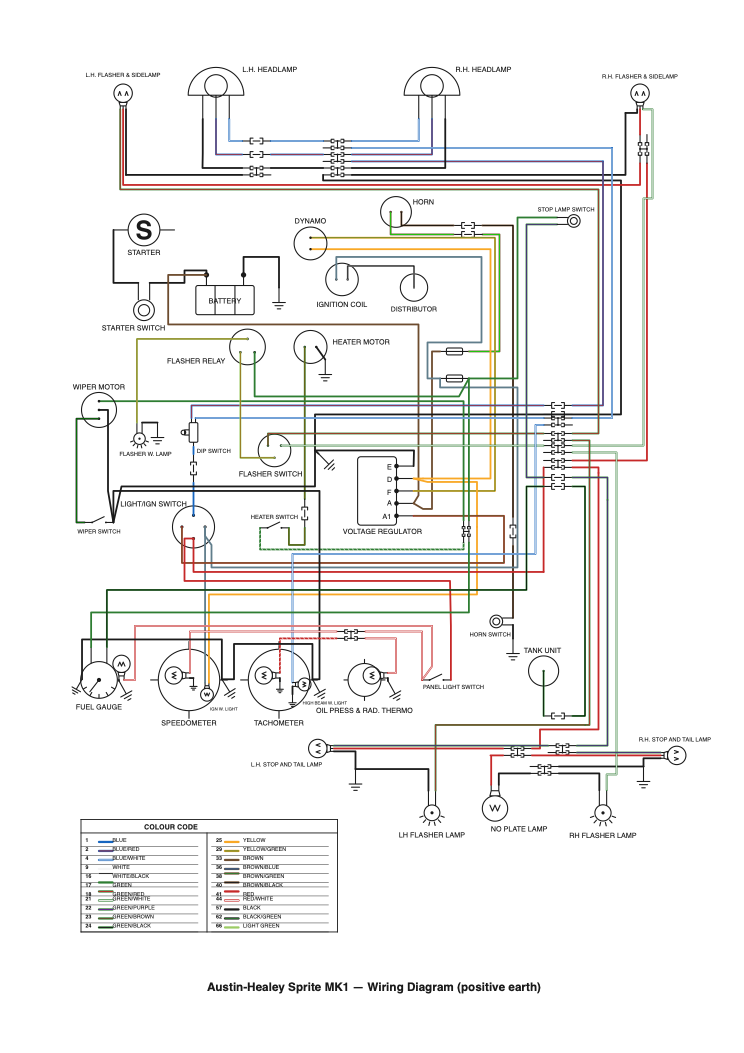
The Real Thing — Austin-Healey Sprite MK1
Our full-color recreation of the complete 1958–61 Sprite (Bugeye) factory wiring
diagram — every wire in correct Lucas colors, vector-sharp at any zoom, and just as live as the
lessons above: turn the ignition key, twist the lighting switch through park and heads, flick the
dip switch, blow fuses, and cut wires to practice diagnosis before you touch the real loom.